International institutions
IMF · World Bank · OECD · WTOCountry analysis, development, trade and multilateral policy questions.
The Insight is preparing this page.
The Insight career field brief · Analysis and Policy
A path for students interested in systems, incentives, policy, markets, research, and analytical reasoning.
Research-led · Policy and markets · Analytical writing
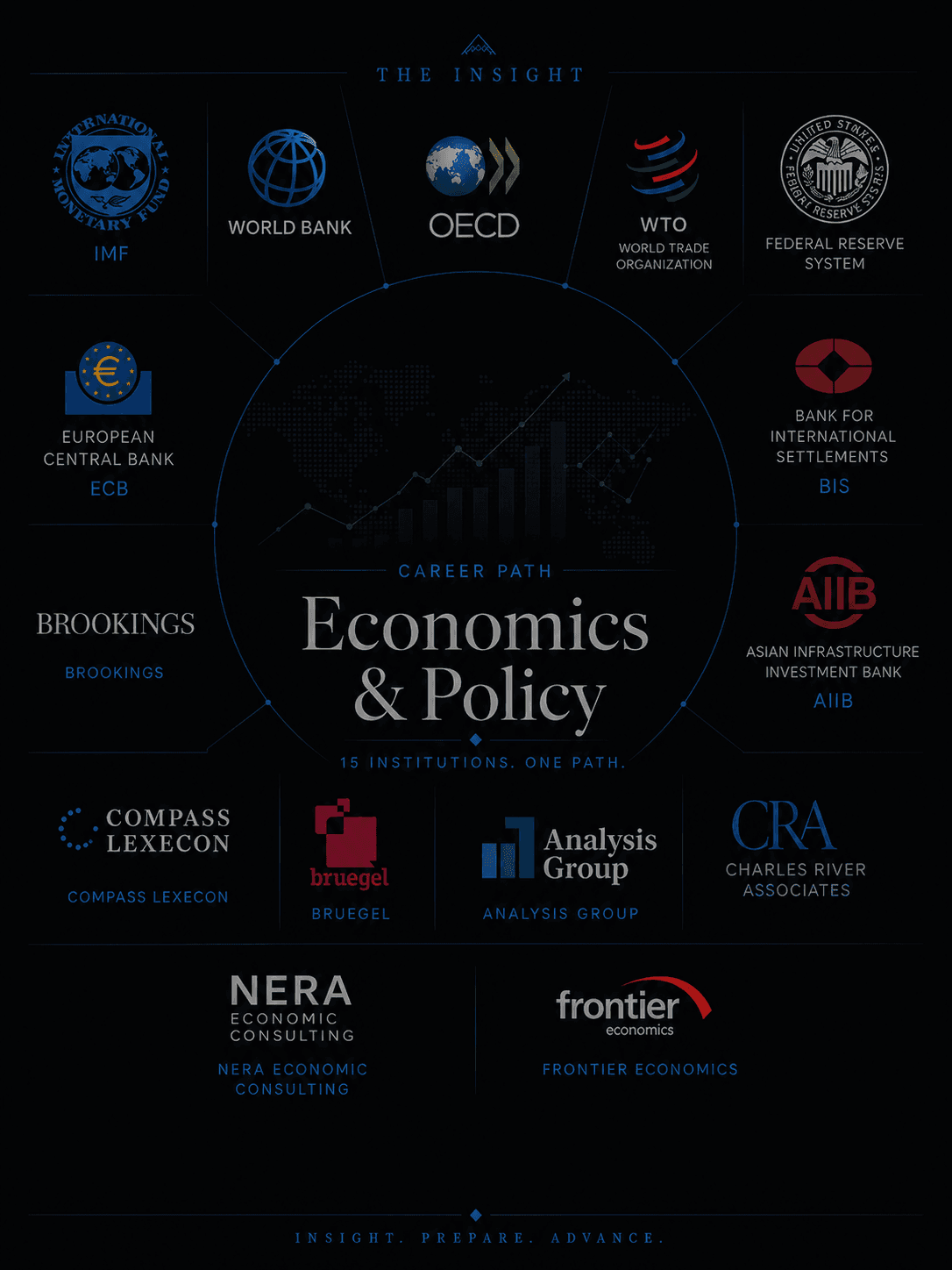
Economics is less a single job than a way of thinking applied across policy, research, finance, and strategy. The key is understanding which branch of economics you actually want to pursue and what skills each branch requires.
Use this short studio to turn curiosity about Economics into evidence about your own working preferences.
Select as many as feel true. There is no score to chase.
Choose a signal to start your reflection.
The sequence below mirrors the recurring work behind research, policy and analytical roles: define a question carefully, test it, and make the limits of the answer explicit.
Clarify the outcome you are trying to explain and the incentives that might drive it.
Open a guide to understand how experienced voices connect Economics to real institutions, choices and working lives.
Use these three moves to discover whether the research process—not just the subject matter—holds your attention.
Compare the purpose of the work before comparing the name on the door.
Country analysis, development, trade and multilateral policy questions.
Macroeconomic, financial-system and monetary-policy research.
Applied analysis for regulation, litigation, competition and corporate decisions.
Economics usually goes deeper into evidence and mechanisms; consulting usually moves faster toward a client recommendation.
Economics investigates markets and incentives broadly; banking executes transactions within them.
Economics often explains systems and policy; quant finance builds technical models for market decisions.
A focused route through the tools, courses, books, data and simulations that help students understand the work—not just the title.
Microsoft Learn · Power BI
Module for Power BI.
Why it’s hereShort introductory module suitable before a larger Power BI pathway.
Microsoft · Presentation Delivery
Tutorial for Presentation Delivery.
Why it’s hereUseful for asynchronous pitches, research presentations and portfolio evidence.
Microsoft · Excel Visualisation
Tutorial for Excel Visualisation.
Why it’s hereOfficial foundation for turning analysis into clear visual output.
Microsoft · PowerPoint Foundations
Tutorial for PowerPoint Foundations.
Why it’s hereA concise starting point for slide structure, text and visuals.
Atlassian University · Jira
Live class / course for Jira.
Why it’s hereIntroduces terms, navigation and work organisation.
Google · Google Colab
Interactive notebook for Google Colab.
Why it’s hereRemoves local setup barriers for Python and data projects.
Zotero · Research Management
Guide for Research Management.
Why it’s hereEssential introduction to collecting, organising and citing sources.
Microsoft · PowerPoint Foundations
Guide for PowerPoint Foundations.
Why it’s hereStep-by-step guide for new users before professional slide design.
Microsoft · Excel Foundations
Tutorial for Excel Foundations.
Why it’s hereClear first lesson on entering, formatting, calculating and charting data.
Listen first, then use the guide and materials to turn passive interest into a practical next step.
Erik Berglöf, Chief Economist of the Asian Infrastructure Investment Bank, joins Christian Hansen to discuss his path between academia and policy, China’s transformation, nature finance, development banking, artificial intelligence, and the value of keeping an open mind.
If you want to become more well read, start with the resources page for structured preparation materials, then work through the related articles below.
Students frequently compare professions through labels, selectivity, and reputation before understanding the labor itself.
Internships do not merely signal ambition to employers. They also help students discover whether the communication load, time structure, and incentives of a field actually fit them.
Academic rigor matters, but many schools still provide surprisingly weak informational infrastructure around careers. Students are often left to make major decisions with shallow context.