Global strategy
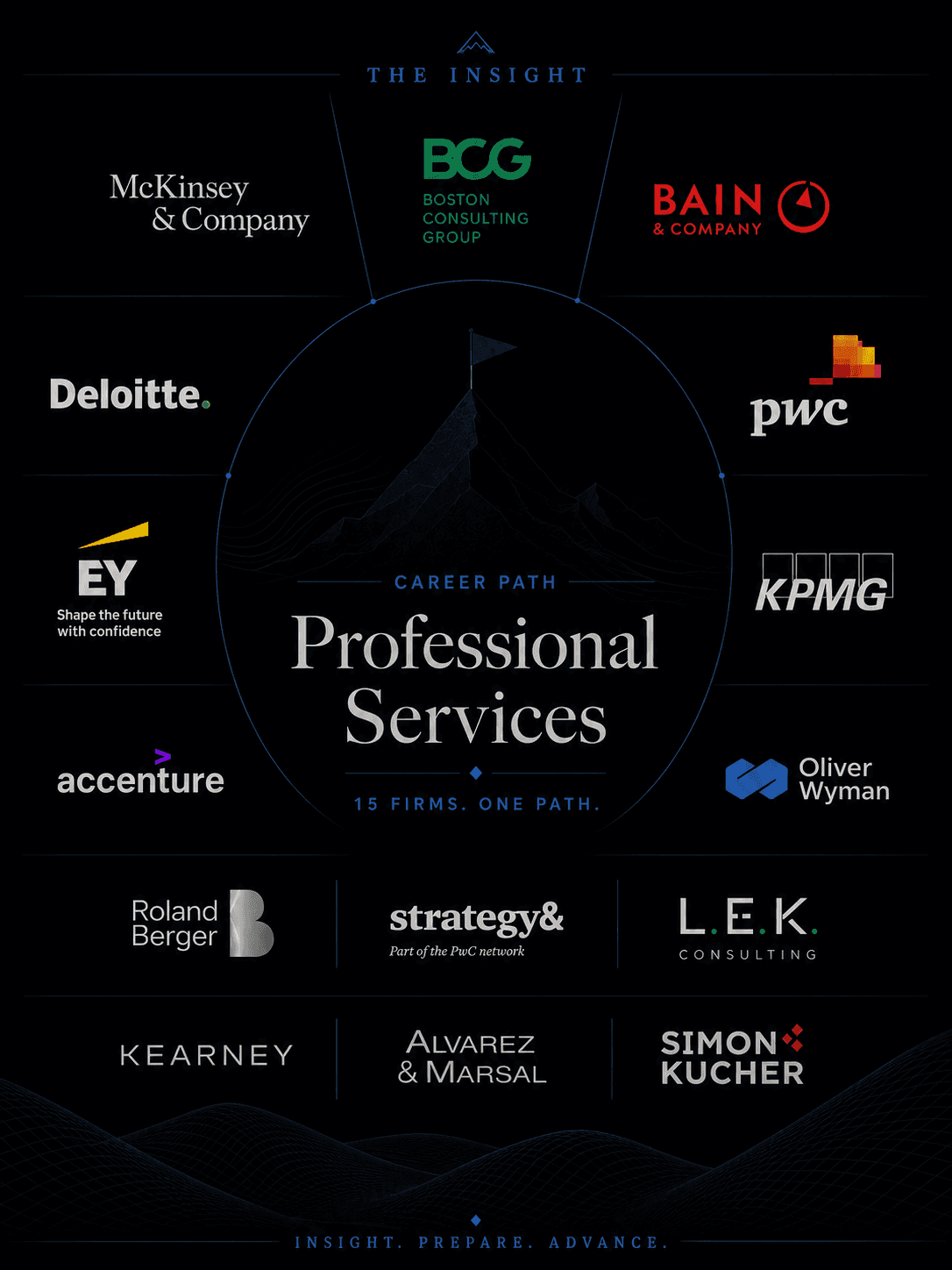
McKinsey · BCG · BainBroad strategic questions, close team staffing and high expectations for structured communication.
The Insight is preparing this page.
The Insight career field brief · Professional Services
From student preparation to internships, full-time recruiting, on-the-job development, and long-term exit paths.
Client-facing · Problem-solving · High collaboration
Consulting attracts ambitious students because it appears broad, selective, and intellectually demanding. But the real work is not just about sounding smart. It is about structured problem-solving, communication under pressure, and client-facing judgment.
Use this short studio to turn curiosity about Consulting into evidence about your own working preferences.
Select as many as feel true. There is no score to chase.
Choose a signal to start your reflection.
This is not a promise of a typical week. It is a realistic sequence of the kinds of work that recur: frame an unclear question, find evidence, make a choice and bring others with you.
Translate a broad concern into a decision, a working hypothesis and the facts that would change the answer.
Open a guide to understand how experienced voices connect Consulting to real institutions, choices and working lives.
Complete these in any order. The value is in noticing what you enjoy, what drains you, and what you want to develop next.
The names on the field cover are a prompt to compare types of work, staffing models and client relationships—not a universal ranking.
Broad strategic questions, close team staffing and high expectations for structured communication.
Large platforms spanning strategy, transformation, risk, technology and implementation.
Different sector strengths, operating styles and degrees of specialisation.
Consulting is organised around a client decision; banking is organised around transaction execution and financial detail.
Consulting typically moves from evidence to a business recommendation; economics can spend longer establishing the evidence itself.
Consulting rewards broad synthesis and persuasion; quant work rewards technical modelling depth and research precision.
A focused route through the tools, courses, books, data and simulations that help students understand the work—not just the title.
Microsoft Learn · Power BI
Module for Power BI.
Why it’s hereShort introductory module suitable before a larger Power BI pathway.
Microsoft · Presentation Delivery
Tutorial for Presentation Delivery.
Why it’s hereUseful for asynchronous pitches, research presentations and portfolio evidence.
Microsoft · Excel Visualisation
Tutorial for Excel Visualisation.
Why it’s hereOfficial foundation for turning analysis into clear visual output.
Microsoft · PowerPoint Foundations
Tutorial for PowerPoint Foundations.
Why it’s hereA concise starting point for slide structure, text and visuals.
Zotero · Research Management
Guide for Research Management.
Why it’s hereEssential introduction to collecting, organising and citing sources.
Microsoft · PowerPoint Foundations
Guide for PowerPoint Foundations.
Why it’s hereStep-by-step guide for new users before professional slide design.
Microsoft · Excel Foundations
Tutorial for Excel Foundations.
Why it’s hereClear first lesson on entering, formatting, calculating and charting data.
Microsoft · Excel Formulas
Tutorial + practice workbook for Excel Formulas.
Why it’s hereOfficial explanation of functions, references, operators and constants.
Microsoft · Excel Formulas
Reference for Excel Formulas.
Why it’s hereA long-term searchable reference for functions used across analytical work.
Listen first, then use the guide and materials to turn passive interest into a practical next step.
If you want to become more well read, start with the resources page for structured preparation materials, then work through the related articles below.
Students frequently compare professions through labels, selectivity, and reputation before understanding the labor itself.
Internships do not merely signal ambition to employers. They also help students discover whether the communication load, time structure, and incentives of a field actually fit them.
The format looks intimidating, but case interviews are less about jargon than many students think. They mainly test structure, synthesis, numerical comfort, and communication.